Introduction
AI-assisted data engineering is no longer a side experiment. For Snowflake teams, it is starting to influence how work is scoped, built, reviewed and moved toward production. The question has also changed. It is no longer simply whether AI can help generate code or configuration. The more important question is whether that output can be shaped into something secure, governed and useful inside a real enterprise environment.
That distinction matters for kipi.ai. The opportunity is not to position Cortex Code as a shortcut that replaces engineering judgement. The stronger story is that Cortex Code can reduce repetitive build friction, while kipi.ai brings the delivery discipline needed to turn that acceleration into a trusted Snowflake pattern.
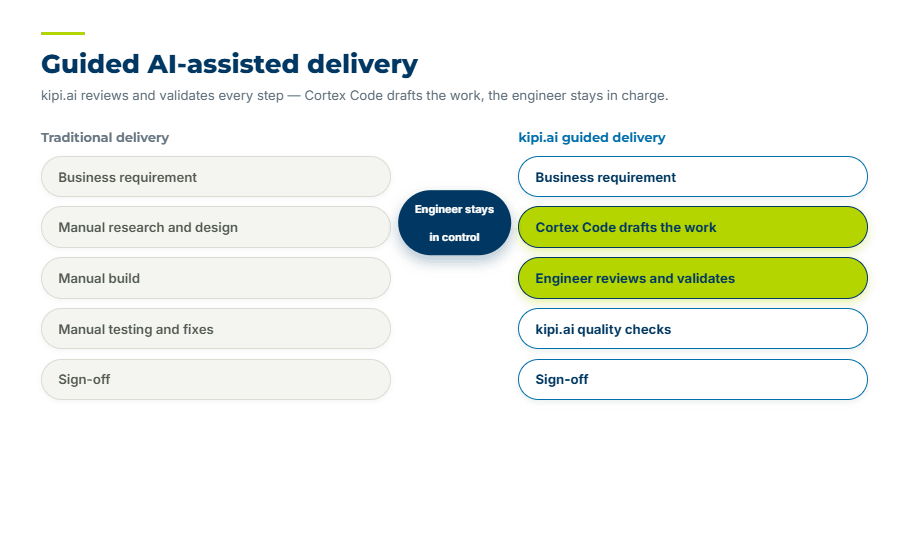
Diagram 1: Manual delivery compared with a kipi.ai-guided Cortex Code delivery pattern.
The Real Bottleneck Is Not Only Code
In many data integration projects, the business goal is clear from the beginning: bring operational, SaaS or collaboration data into Snowflake so it can be used more effectively. The delay often sits in the layer between that intent and a production-ready implementation.
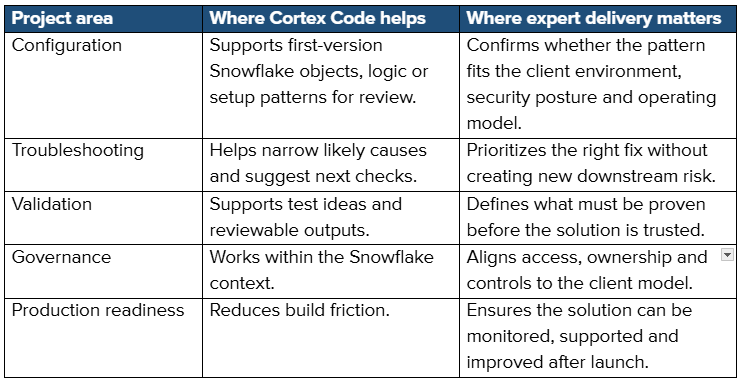
That middle layer is full of decisions. Teams need to confirm access design, credential handling, network controls, source readiness, validation and supportability. Cortex Code can help reduce friction in this space by supporting configuration drafts, clarifying dependencies and helping teams reason through likely troubleshooting paths. But the output still needs review. That is where the consultancy value becomes clear: knowing which pattern is appropriate, which risks matter and what must be proven before production.
A Better Way To Frame AI-Assisted Engineering
The strongest use case for Cortex Code is not “AI builds the pipeline.” A more credible framing is that AI helps engineering teams move faster through configuration-heavy work, giving them more time to focus on architecture, validation and control.
That framing is important. kipi.ai is not selling a simple tool story. It is showing how AI assistance can sit inside a delivery method that still respects security, governance and business context. The value is not less engineering. The value is better-directed engineering.
Where This Leaves Data Teams
The real shift is from manual assembly to guided, reviewable execution. Teams can spend less time fighting syntax and more time proving that the data is accurate, accessible and ready to be used.
That is the foundation for the rest of this series. Each article explores a source-to-Snowflake pattern where Cortex Code can reduce friction, while kipi.ai helps shape the work into a trusted production approach.
Ready to see the difference? Connect with the kipi.ai team to explore how Cortex Code can transform your data practice.
About kipi.ai
Kipi.ai, part of Capgemini, is a global leader in data modernization and democratization focused on the Snowflake platform. Headquartered in Houston, Texas, Kipi.ai enables enterprises to unlock the full value of their data through strategy, implementation and managed services across data engineering, AI-powered analytics and data science.
As a Snowflake Elite Partner, Kipi.ai has one of the world’s largest pools of Snowflake-certified talent—over 600 SnowPro certifications—and a portfolio of 250+ proprietary accelerators, applications and AI-driven solutions. These tools enable secure, scalable and actionable data insights across every level of the enterprise. Serving clients across banking and financial services, insurance, healthcare and life sciences, manufacturing, retail and CPG, and hi-tech and professional services, Kipi.ai combines deep domain excellence with AI innovation and human ingenuity to co-create smarter businesses. As a part of Capgemini, Kipi.ai brings global scale and execution strength to accelerate Snowflake-powered transformation world-wide.
For more information, visit www.kipi.ai.