Introduction
Most reporting gaps start long before the dashboard. They begin when operational systems change faster than analytics can refresh. Transactions are updated, records are changed and business events keep moving, while reporting teams wait for scheduled extracts or overnight jobs before that information becomes visible.
Change Data Capture helps close that gap by identifying changes in the source system and moving them into Snowflake more continuously. The exact implementation will differ by client, but the delivery pattern is consistent: understand the source, capture the right changes, orchestrate movement, land the data in Snowflake and validate that the result can be trusted.
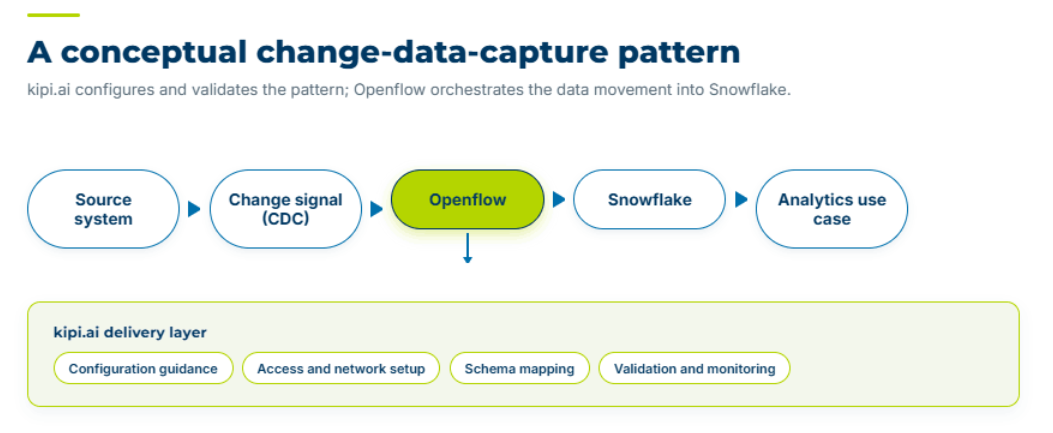
Diagram 2: A conceptual CDC pattern into Snowflake, showing Openflow, Cortex Code and kipi.ai delivery guidance.
From connector thinking to delivery thinking
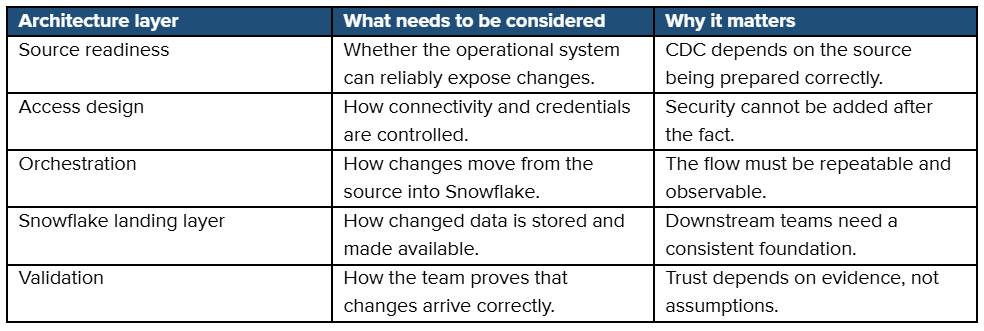
The PostgreSQL proof point behind this article demonstrates why CDC should not be treated as a connector-only exercise. A connector may move data, but a trusted CDC pattern depends on the decisions around it: source readiness, access design, orchestration, Snowflake landing design, validation and support.
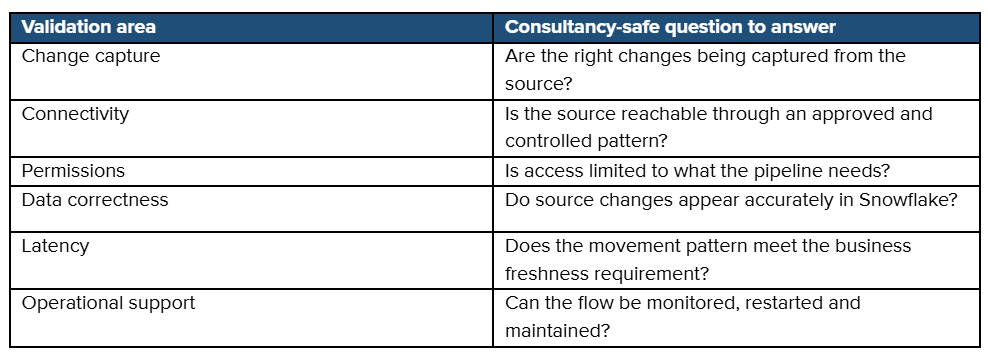
This is where the work becomes consultative. Before production, the team needs to prove that the right changes are being captured, that access is controlled, that the flow is repeatable and that downstream teams can rely on the Snowflake data layer.
Where Cortex Code made the work more efficient
Cortex Code was useful around the Snowflake engineering layer. It supported reviewable configuration thinking, helped reduce time spent moving between documentation and syntax, and gave the team a faster way to reason through validation steps.
The important point is that the team still owned the review. Cortex Code accelerated the path to a workable pattern, while the implementation team retained responsibility for architecture, security and production judgement.
Why this matters beyond the first successful sync
CDC projects are often judged too early, usually at the point where data first starts to move. That is only the first test. The more important question is whether the data moves securely, consistently and in a way the business can trust over time.
By combining Openflow orchestration, Cortex Code assistance and kipi.ai delivery discipline, teams can reduce implementation friction without reducing the review and control that production Snowflake environments require.
Ready to see the difference? Connect with the kipi.ai team to explore how Cortex Code can transform your data practice.
About kipi.ai
Kipi.ai, part of Capgemini, is a global leader in data modernization and democratization focused on the Snowflake platform. Headquartered in Houston, Texas, Kipi.ai enables enterprises to unlock the full value of their data through strategy, implementation and managed services across data engineering, AI-powered analytics and data science.
As a Snowflake Elite Partner, Kipi.ai has one of the world’s largest pools of Snowflake-certified talent—over 600 SnowPro certifications—and a portfolio of 250+ proprietary accelerators, applications and AI-driven solutions. These tools enable secure, scalable and actionable data insights across every level of the enterprise. Serving clients across banking and financial services, insurance, healthcare and life sciences, manufacturing, retail and CPG, and hi-tech and professional services, Kipi.ai combines deep domain excellence with AI innovation and human ingenuity to co-create smarter businesses. As a part of Capgemini, Kipi.ai brings global scale and execution strength to accelerate Snowflake-powered transformation world-wide.
For more information, visit www.kipi.ai.